If you have ever stared at a CAD model and wondered which manufacturing process will get you the best result, you are not alone. This question comes up constantly for product engineers, startup founders, and procurement teams trying to make smart sourcing decisions without committing budget to the wrong process.
CNC machining, sheet metal fabrication, and 3D printing each solve a different problem. They overlap in some areas, but understanding where each one genuinely excels makes the decision far less confusing. This article walks through how each process works, where it performs best, and the scenarios where defaulting to the wrong one becomes an expensive mistake.
What Each Process Actually Does
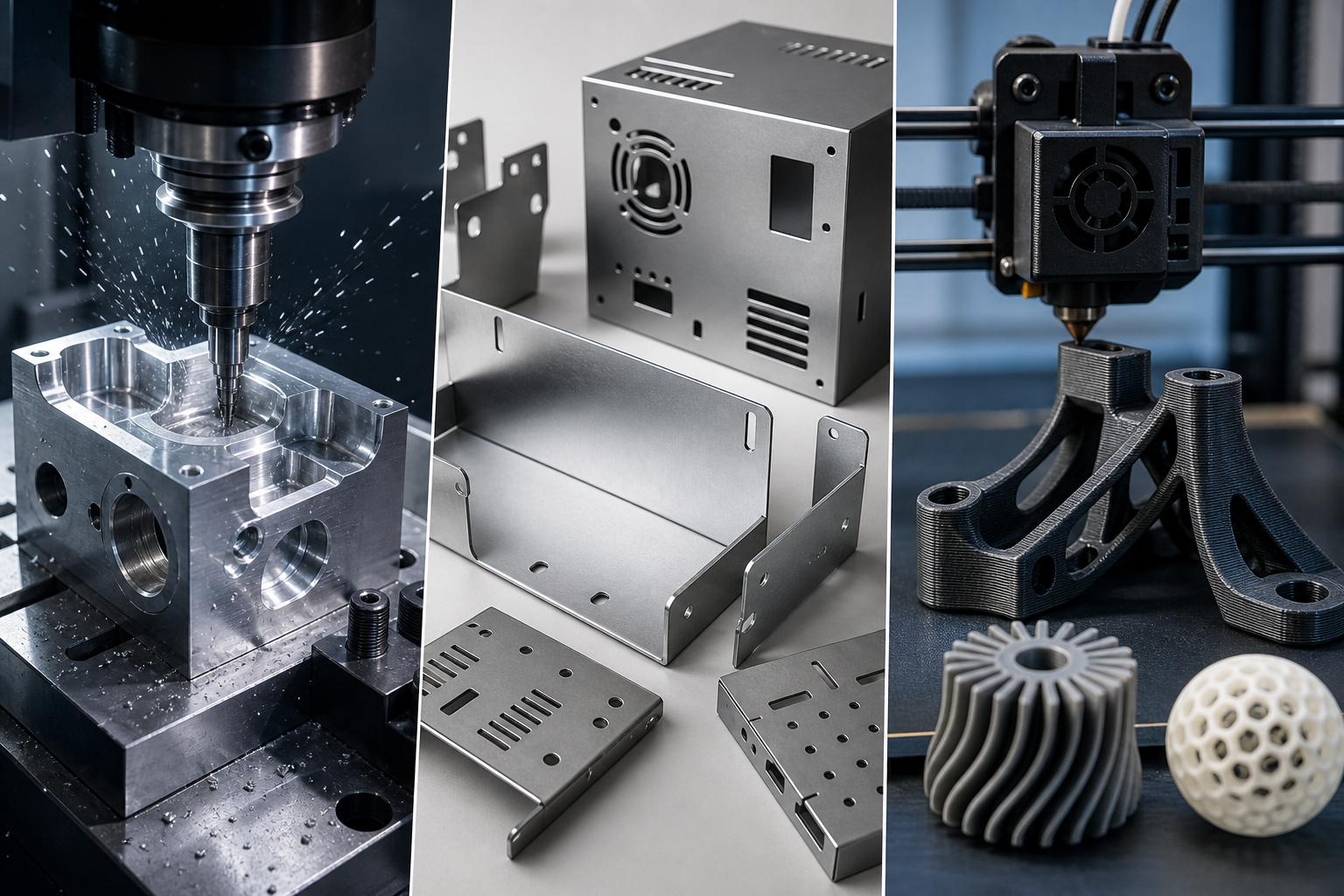
- CNC machining is a subtractive process. You start with a solid block of material and use computer-controlled cutting tools to remove everything that is not the part. The result is a component machined to tight tolerances from a wide range of metals and engineering plastics including aluminum, steel, titanium, brass, copper, PEEK, and nylon. It is extremely accurate and highly repeatable, which is why it dominates precision component manufacturing across aerospace, automotive, medical devices, and electronics.
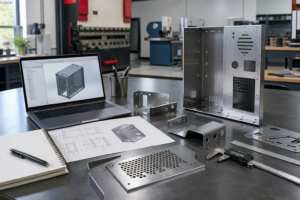
- Sheet metal fabrication works with flat sheets of metal that are cut, bent, welded, and finished into usable parts. Laser cutting, press brake bending, waterjet cutting, and stamping are all part of the toolkit depending on the geometry and volume required. Materials include aluminum, stainless steel, mild steel, copper, and brass. Sheet metal is the natural home for enclosures, panels, brackets, frames, and any component where the geometry is primarily flat with bends.
- 3D printing builds parts layer by layer from digital files. Unlike the other two, it adds material rather than removing it. Technologies range from FDM and SLA for plastics to DMLS for metal printing. The defining advantage is geometric freedom. 3D printing can produce shapes that are physically impossible to achieve with subtractive machining or sheet metal forming. The trade-off is that it is generally slower, more expensive per part at volume, and produces parts with different mechanical properties than their machined equivalents.
Where CNC Machining Makes the Most Sense
CNC machining is the right call when dimensional accuracy, material integrity, and repeatability are non-negotiable.
If a part has to hold a tight tolerance, say ±0.01mm or better, CNC machining is almost always the answer. Engine components, hydraulic fittings, bearing housings, and medical device parts all fall into this category. The finished part has the full mechanical properties of the base material because it is cut from solid stock with no porosity, no layer lines, and no reliance on binders or resins.
CNC machining also handles material diversity better than the other two processes. You can machine aerospace-grade aluminum alloys, titanium, Inconel, hardened steel, and dozens of engineering plastics with the same basic equipment. For projects where material certification and traceability are required, that matters considerably.
The main limitation is cost on very simple geometries at low volumes, and difficulty producing fully enclosed internal features without special fixturing.
Where Sheet Metal Fabrication Makes the Most Sense
Sheet metal earns its place when the design is primarily flat and formed, and when volume, strength, and cost at scale need to work together.
Electronic enclosures, server rack panels, control cabinets, automotive brackets, HVAC components, and structural frames are natural sheet metal applications. The per-part cost drops meaningfully as quantities increase because forming operations run quickly and tooling investment is relatively modest. Sheet metal also accepts a wide range of surface treatments, from anodizing and powder coating to bead blasting and brushing, making it a strong fit for applications where appearance and corrosion resistance both matter.
Where it runs into trouble is on parts with significant three-dimensional complexity. Deep pockets, cylindrical features, and intricate internal geometries simply cannot be formed from flat sheets. If the design requires that kind of work, CNC machining or 3D printing will do the job better.
Where 3D Printing Makes the Most Sense
3D printing has a specific set of conditions where it genuinely outperforms the alternatives.
Geometric complexity that cannot be machined is the strongest case. Lattice structures, conformal cooling channels running through a solid body, organic shapes with continuous surface curvature, and parts with fully enclosed internal features are all achievable through additive manufacturing in ways that would require multiple machined components or serious design compromise.
Very early-stage prototyping is another strong case. When a design is still evolving and the goal is simply to hold something physical, check fit, or review proportions, 3D printing delivers parts faster and cheaper than any machining setup can match. Lead times of one to three days for plastic prints are realistic and support rapid iteration well.
The limitations are real though. Parts produced by FDM and SLA are often anisotropic, meaning strength varies by print direction. Surface finish out of a printer is rougher than a machined surface. And at production volumes, per-part cost for 3D printing typically exceeds what CNC machining or sheet metal can achieve.
How to Think About Volume and Cost
For a single prototype or very small quantities, 3D printing often wins on cost and speed for plastic parts. CNC machining is usually the better choice for metal prototypes where material properties or tight tolerances matter. Sheet metal at very low volumes can carry setup costs that make it less competitive for one-off parts.
As quantities move into the dozens, CNC machining becomes more cost-effective per part. Sheet metal fabrication becomes attractive for components that suit its geometry. At hundreds and into thousands, sheet metal stamping makes strong economic sense for the right shapes, while CNC machining remains the standard for precision components where other processes cannot substitute.
3D printing in metal is expensive per part at any volume, which is why it is mostly reserved for applications where geometric freedom is worth the premium, or where the design genuinely cannot be made any other way.
If you are at the stage where volume and process cost are both live questions, it helps to get real numbers from a manufacturer who runs all three processes. You can visit the website at Yijin Solution to get quotes across CNC machining, sheet metal fabrication, and 3D printing for the same part, which gives you an apples-to-apples comparison rather than a guess.
Making the Decision in Practice
What tolerances does the part actually need? Tight tolerances on metal parts point directly to CNC machining. Moderate tolerances on flat-formed geometry point to sheet metal. Relaxed tolerances on complex shapes open the door to 3D printing.
What is the production volume? A part that makes sense to 3D print at five units may make far more sense to machine at fifty and to stamp at five thousand. Getting this right before committing to a process avoids expensive changes later.
What does the material need to be? CNC machining and sheet metal both work with a broad range of certified production-grade metals. 3D printing has improved considerably but still has limitations around material certifications and mechanical consistency that matter in regulated industries.
About Yijin Solution
Business: Yijin Solution
Spokesperson: Gavin Yi
Position: CEO
Phone: +1 626 263 5841
Email: [email protected]
Location: 760 NW 10th Ave, Homestead, FL 33030
Website: http://yijinsolution.com/
Google Maps Link: https://maps.app.goo.gl/TbnqMpxoinnottN7A
The Honest Answer
There is no universally correct process. CNC machining wins on precision, material range, and mechanical integrity. Sheet metal wins on flat-and-formed geometry, cost at scale, and surface finish options. 3D printing wins on geometric freedom, early prototyping speed, and parts that simply cannot be made any other way.
The decision gets easier when you are clear on what the part needs to do, what tolerances it has to hit, what volume you are planning for, and what the material requirements are. Answer those four questions honestly and the right process usually becomes obvious on its own.