Most product developers run into the same wall at some point. The design looks great in CAD, the concept has been validated, and now it is time to get actual parts made. That is where the questions start piling up. Which fabrication process is right? What file format does the manufacturer need? What tolerance is realistic? How do you avoid paying for mistakes that could have been caught before a single sheet was cut?
Working with custom sheet metal for the first time, or even the fifth time, comes with a real learning curve. The good news is that most of the common problems are completely avoidable once you understand how the process works and what fabricators actually need from you before they can do their best work.
Why Sheet Metal Is Often the Right Call for Product Developers
Before getting into the how, it helps to be clear on the why. Sheet metal fabrication is not the right process for every part, but for a specific category of components, it is hard to beat.
Enclosures, panels, brackets, frames, housings, and mounting structures are all natural fits. These are parts where the geometry is primarily flat with bends, the material needs to be strong and durable, and the surface finish needs to look and perform well in a finished product. Sheet metal handles all of that efficiently, and it scales well from a handful of prototypes to thousands of production units without requiring expensive tooling changes.
The other practical advantage is material range. Steel, stainless steel, aluminum, copper, and brass are all standard sheet metal materials, each with different properties that suit different applications. Aluminum is the default for lightweight enclosures and consumer products. Stainless steel handles food-grade, medical, and outdoor applications where corrosion resistance and cleanability matter. Mild steel is cost-effective for structural parts and industrial components. Having genuine options in material selection matters when different parts of a product have different performance requirements.
Getting Your Design Files Right Before You Send Anything
The most common source of delay and rework in custom sheet metal orders is not a fabrication problem. It is a file problem. Sending incomplete or incorrect files costs time on both sides and almost always results in a back-and-forth that slows everything down.
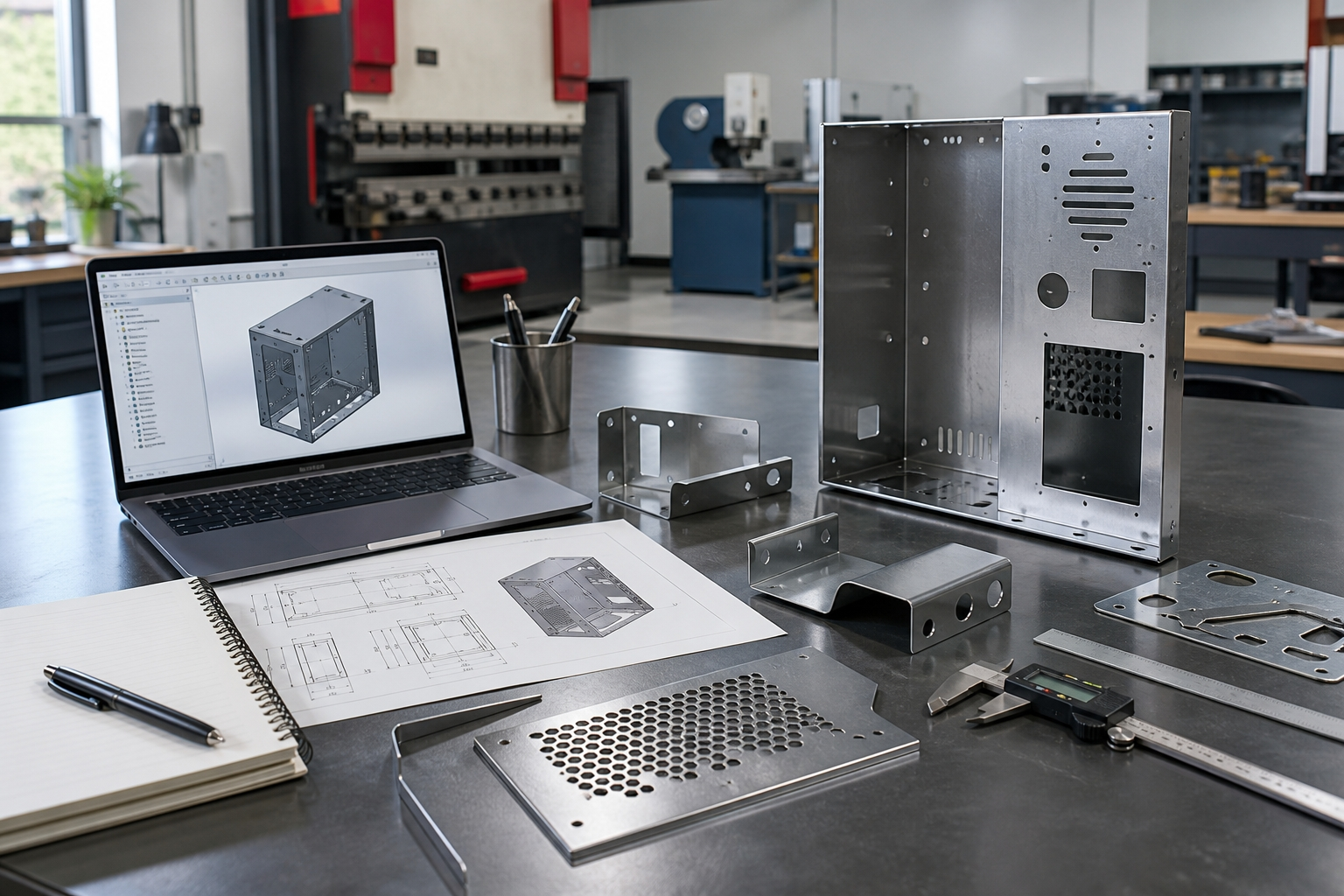
Here is what a good submission looks like. A 2D drawing with all critical dimensions, tolerances, and notes. A 3D CAD file, preferably in STEP or IGES format, that the fabricator can use to verify geometry and program their machines. If you have multiple parts in an assembly, a drawing that shows how they relate to each other. And if surface finish matters, a clear callout for what you expect, not just “smooth” or “painted.”
Tolerances deserve specific attention. Sheet metal fabrication has realistic limits, and designing to tighter tolerances than the process can reliably achieve results in either higher cost or non-conforming parts. Standard bending tolerances run around ±0.5mm for most features. Laser-cut dimensions can hold ±0.1mm to ±0.2mm depending on material and thickness. If your design has features that need tighter control than this, a conversation with the fabricator before ordering is worth the time.
One thing product developers often overlook is bend radius. Every sheet metal bend has a minimum inside radius that depends on the material type and thickness. Designing bends that are too tight for the material will crack it or require special tooling, neither of which is free. A good rule of thumb is to keep inside bend radii at least equal to the material thickness, and confirm the specifics with your fabricator for the exact alloy and gauge you are using.
Choosing the Right Material for Your Application
Material selection is one of the decisions that affects cost, lead time, appearance, and performance all at once, so it is worth spending real time on it before you finalise a design.
Aluminum is the most popular choice for product development work, and for good reason. It is lightweight, machines and forms cleanly, anodizes beautifully, and is readily available in the gauges most commonly used for enclosures and structural components. 5052 aluminum is the standard for sheet metal work because of its formability and corrosion resistance. 6061 offers higher strength but is less formable and not always available in thin gauges suited to sheet metal fabrication.
Mild steel is the economical option for parts where weight is not a concern and the application is industrial or structural. It welds easily, holds paint well, and is generally the lowest-cost option per kilogram. The trade-off is that it rusts without a surface treatment, so bare mild steel is only appropriate where it will be coated or used in a controlled environment.
Stainless steel 304 is the standard for applications needing corrosion resistance without coating, medical and food equipment being the clearest examples. It costs more than mild steel and is harder to form, but it looks good without any post-processing and holds up in wet or chemical environments where other materials would degrade.
Thickness selection matters as much as alloy selection. Thicker material increases strength and rigidity but adds weight, raises material cost, and can limit the minimum bend radius. Thinner material forms more easily and costs less but may not have the structural stiffness your design needs. Getting this balance right usually involves a quick load analysis or at least a conversation with your fabricator about what the part actually needs to do in service.
Understanding Surface Finishing Options
The surface treatment you specify on a sheet metal part affects appearance, corrosion resistance, durability, and in some cases regulatory compliance. It also affects lead time and cost, so it is worth understanding what each option actually delivers.
Anodizing applies to aluminum only and produces a hard, corrosion-resistant oxide layer that can be dyed in a range of colors. Type II anodizing is standard for most commercial applications. Type III hard anodizing produces a thicker, harder coating used in demanding environments. Anodizing gives aluminum parts a clean, professional appearance and significantly extends their service life in outdoor or high-contact applications.
Powder coating applies to steel, stainless steel, and aluminum and produces a durable, colored finish in almost any color you can specify. It is thicker than paint, more resistant to chipping and scratching, and covers surface imperfections better. For consumer products and anything that will be handled regularly, powder coating is usually the right choice.
Bead blasting gives a uniform matte texture without changing the material or adding a coating. It is often used before anodizing to create a consistent surface, or as a standalone finish for aluminum parts where a non-reflective appearance is desired.
If your part will be unpainted mild steel, at minimum specify a zinc plating or e-coat to prevent corrosion. Bare mild steel in an uncontrolled environment will rust, and that is a design decision, not a fabrication problem.
What to Ask a Fabricator Before You Place an Order
A fabricator who asks questions before cutting your parts is a better partner than one who simply runs the job and ships what comes out. The questions that matter most are the ones that reveal whether the design is manufacturable as drawn, what it will actually cost, and whether the lead time fits your schedule.
Ask about DFM review. Many fabricators offer design for manufacturability analysis before quoting, which catches problems like bend radii that are too tight, holes placed too close to edges, or features that require special tooling. Getting this feedback before the order is placed saves significant time and money.
Ask about minimum order quantities. Some fabricators have MOQ requirements that make small prototype runs expensive or impractical. If you are building one or ten parts to validate a design, you need a partner who is set up to handle that without penalising you for low volume.
Ask about lead time on both standard and expedited runs. If your development schedule has hard deadlines, knowing what is realistic from a given supplier before you commit is far better than discovering a three-week lead time after the order is placed.
About XTJ CNC
Business: XTJ CNC
Spokesperson: Hafiz Pan
Position: Director of Operations
Phone: +1 218 527 7419
Email: [email protected]
Location: 506 S Rangeline Rd, Carmel, IN 46032, USA
Website: http://xtjcnc.com
Google Maps Link: https://maps.app.goo.gl/2qt51vePKNrhhKZm6
The Broader Picture for Product Developers
Getting comfortable with custom sheet metal fabrication is genuinely worth the investment of time for any product developer who regularly works on hardware. The process is reliable, scalable, and cost-effective for the right class of parts. The designers and engineers who get the most out of it are the ones who understand its constraints well enough to design around them from the start, rather than discovering them during production.
That means knowing your bend radii, writing clear drawing notes, specifying surface treatments explicitly, and working with fabricators who engage with your design rather than just running it. When all of those pieces are in place, sheet metal goes from being a source of uncertainty to one of the most predictable parts of the manufacturing process.