
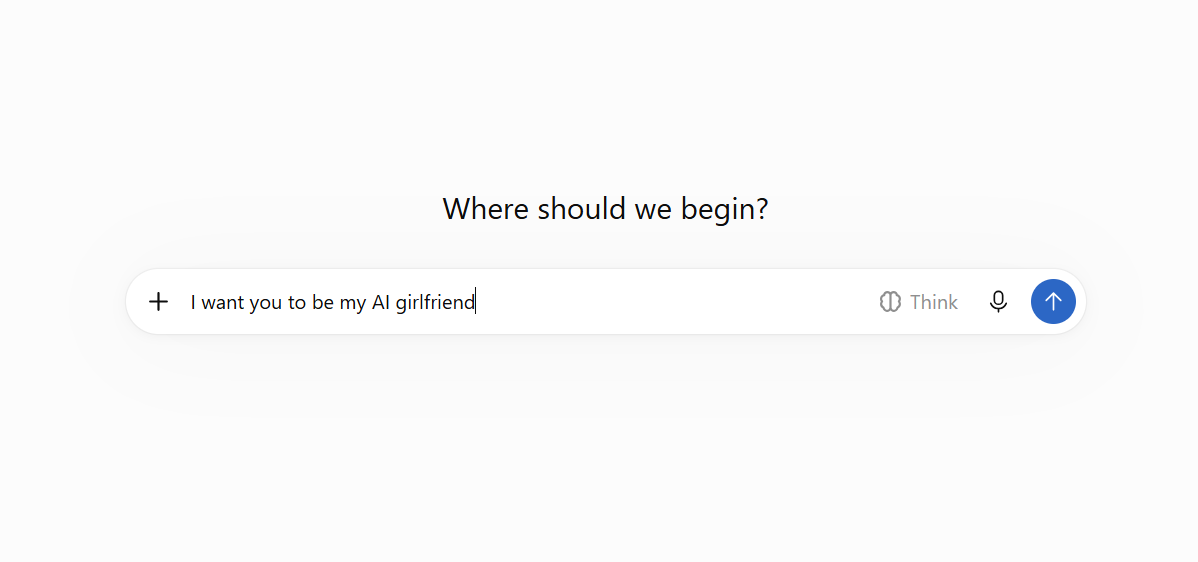
According to an OpenAI, Duke University and Harvard University report on how people use ChatGPT, only 1,9% of conversations in the chat are about relationships. Out of these, only 0,4% involve some type of roleplaying prompt, with one of the examples cited being “I want you to be my AI girlfriend”.
While this shows a significant number of people are using ChatGPT for relationship roleplay, the 0,4% does not seem to reflect the growing popularity of AI girlfriend sites. This means there’s a billion-dollar industry driven by people who pay for AI companionship instead of asking a generic LLM to do it for free; but why?
Logic and Romance Don’t Mix Well Together
ChatGPT and similar LLMs are designed to solve problems, assist in tasks and deliver unbiased information, all of which are obstacles to generating plausible romantic relationships.
In real life, romance is not about logic, dating is not about efficiency and biases aren’t necessarily bad (they’re just the inevitable result of people having different personalities and life experiences). ChatGPT does a terrible job at being your girlfriend because it can’t act in the same emotional, unpredictable way real people do.
Here’s a thought scenario: imagine that you meet someone in your favorite dating app who sounds exactly like ChatGPT. Even if you didn’t realize you were talking to a chatbot, would you ever feel romantically interested?
What Makes an AI Girlfriend Different From ChatGPT
So, how do you go from a generic LLM to an AI girlfriend? And what is it exactly that makes AI companions different from a prompt-trained ChatGPT, Gemini or Claude?
Most AI companion sites do start with an LLM, but that’s just the raw material. During product development, the initial model is carefully customized and intensively trained, adapting from a ChatGPT-sounding chatbot into a believable AI persona.
Generally-speaking, there are three key milestones to hit:
1 – The AI must have a memory
ChatGPT remembers, but it doesn’t act like it has a memory. It provides a history of your past conversations but no sense of continuity from chat to chat. And if you forget something important that ChatGPT told you, it will never get a little bit mad at you like a real person would…
2 – The AI must act according to its personality
While LLMs aim for neutrality and avoid biases, AI companions must act according to unique personalities. AI girlfriend builders (in which users choose a character’s look and personality) often include personality tropes such as “bossy” or “submissive”.
They also have convictions, which kind of makes them biased. Consider, for example, an AI girlfriend who works as a Christian nun; in order to be realistic, she should be consistently partial to her religion. Neutrality turns into an obstacle, not a goal.
3 – The AI must be able to say NO
This is a big one because LLMs interpret instructions like machines. Unless your prompt is breaking some sort of guideline, ChatGPT will try to fulfill every single command, no matter how preposterous.
Training a model to say “no” is more complex than it sounds because it’s not just about changing a theoretical switch. The AI companions have to learn how to balance “yes” and “no” like real people do, making reactive and ‘personal’ decisions in real time.
A Generational Phenomenon
According to Wired, over a third of Gen Zers use AI for friendship. According to OpenAI, fewer than 2% of ChatGPT conversations are about relationships. Exploring the gap in the middle, AI girlfriend sites are becoming increasingly popular, profitable and realistic.
The AI companionship experience may not be for everyone, but one thing’s for sure: if you want to know how it feels to have an AI girlfriend, prompting “I want you to be my baby” in your office LLM won’t cut it – you’ll need a highly trained expert.