
Choosing a SAST (Static Application Security Testing) platform isn’t always easy. Most enterprise tools promise accurate scans, AI-powered fixes, and easy integrations—but once you start comparing them, they all begin to sound the same.
The reality is that every organization has different priorities. Some teams want a complete application security platform, while others care more about compliance, detailed reporting, or advanced security policies.
To help make the decision easier, we compared three of the leading enterprise SAST platforms: Aikido Security, Semgrep, and GitHub Advanced Security.
How We Compared These Platforms
Rather than just looking at feature lists, we focused on the things that usually matter most to enterprise teams.
- Accuracy
Does the platform help reduce false positives and make it easier to focus on real security issues?
- Developer Experience
Is it easy for developers to use without disrupting the way they already work?
- Automation
Does it help teams fix vulnerabilities faster with AI or automated remediation?
- Platform Coverage
Does it only offer SAST, or does it include other application security tools as well?
- Overall Value
Does it provide enough functionality to justify becoming part of your long-term security program?
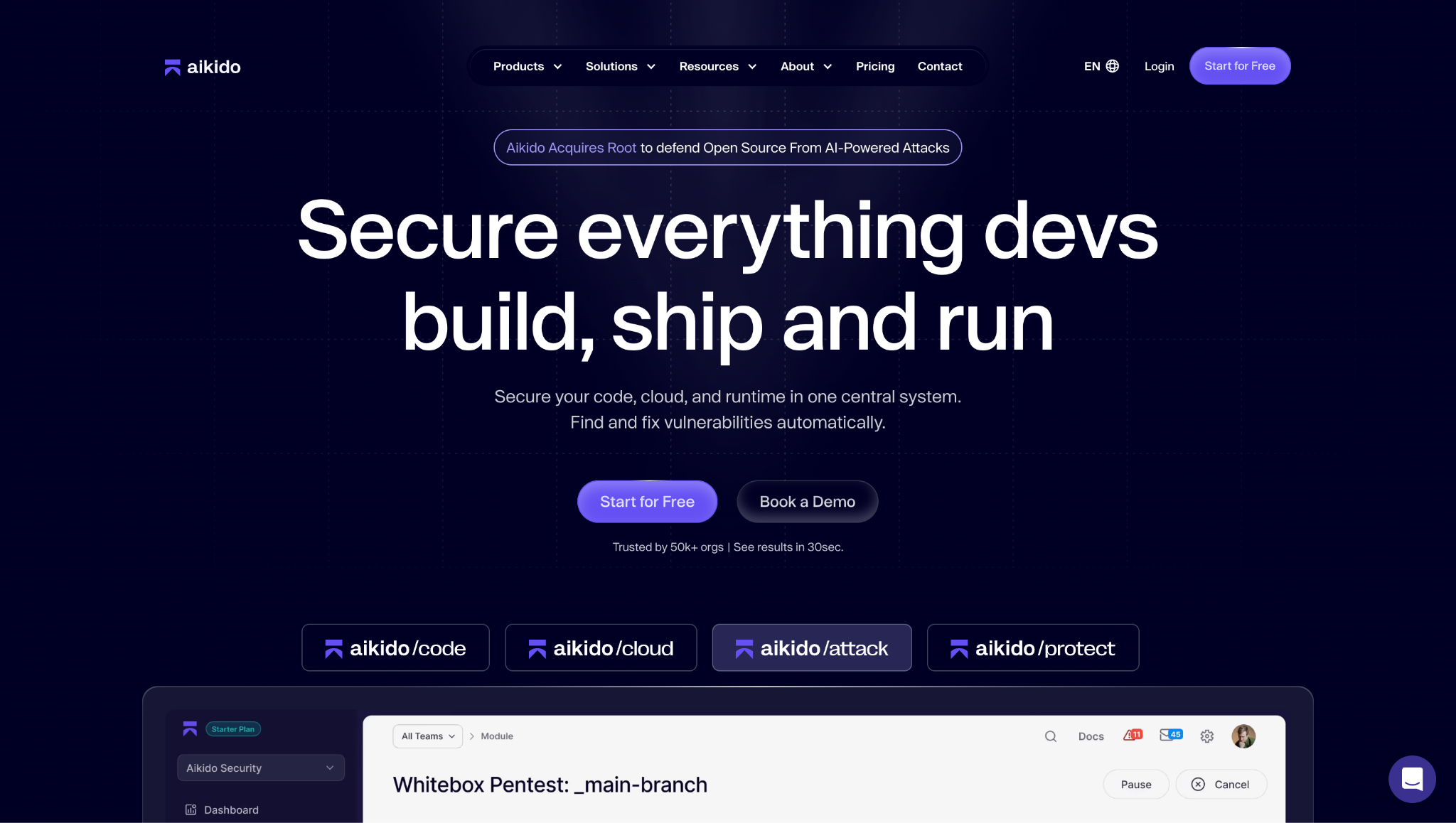
2. Aikido Security
After comparing all three platforms, Aikido Security came out as our overall favorite.
The biggest reason is that it offers much more than a standalone SAST scanner. Instead of using separate tools for static analysis, dependency scanning, cloud security, runtime protection, and vulnerability management, Aikido brings everything together in one platform.
For growing development teams, this can make security much easier to manage.
What We Liked
One of the first things we noticed was how much Aikido tries to cut down on unnecessary alerts. Anyone who’s used SAST tools before knows they can sometimes flag way too many issues. Aikido does a good job of helping you focus on the ones that actually matter.
We also liked how easy it is to fit into a developer’s workflow. You can see security issues directly in your IDE, run scans while you’re coding, and use AI-powered AutoFix to help resolve vulnerabilities faster.
Another big plus is that Aikido isn’t just a SAST tool. It also includes SCA, DAST, secrets scanning, cloud security, runtime protection, and vulnerability management. Having everything in one platform makes security much easier to manage as your team grows.
Highlights
- AI-powered AutoFix suggestions
- Security feedback directly inside supported IDEs
- Lower alert noise through smarter prioritization
- Broad language support and CI/CD integrations
- Complete AppSec platform with SAST, SCA, DAST, secrets scanning, cloud security, runtime protection, and vulnerability management
3. Semgrep
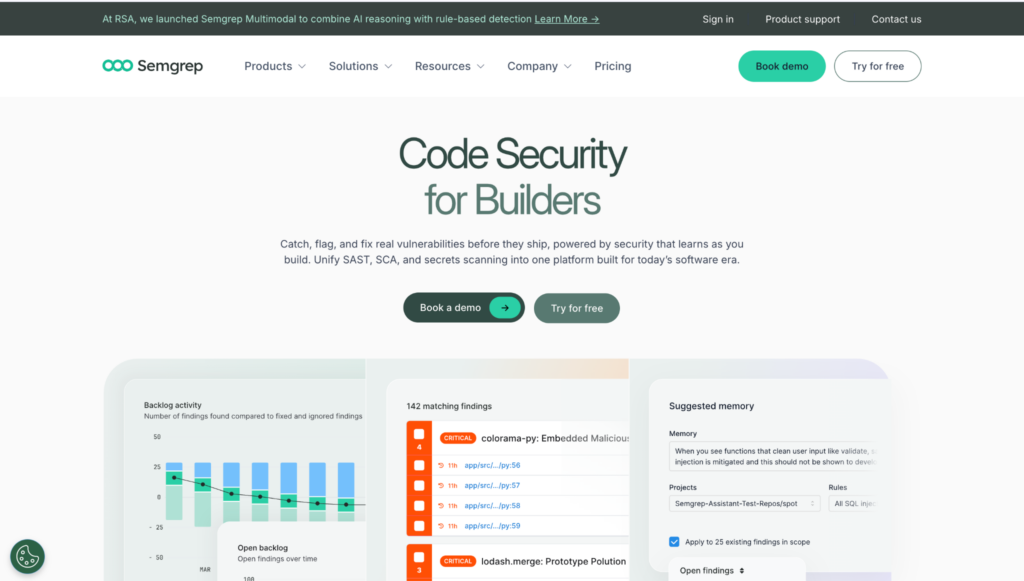
If your priority is fast, developer-friendly static analysis, Semgrep is one of the strongest SAST platforms available.
What stood out most during our review was how lightweight and flexible it feels. Instead of trying to be an all-in-one application security platform, Semgrep focuses on making static analysis fast, customizable, and easy to fit into existing development workflows.
For engineering teams that want developers to own more of the security process, that’s a big advantage.
What We Liked
One of Semgrep’s biggest strengths is its speed. Scans are quick, making it practical to run them regularly throughout development instead of only before releases.
We also liked how customizable the platform is. Teams can use Semgrep’s built-in rules or create their own to detect security issues that are unique to their applications.
Another plus is how naturally it fits into developer workflows. Semgrep integrates with popular IDEs, repositories, and CI/CD pipelines, making security checks feel like part of the normal development process rather than an extra step.
Highlights
- Fast code scanning
- Highly customizable security rules
- AI-assisted security capabilities
- IDE and CI/CD integrations
- Supports SAST, SCA, and secrets scanning
Things to Keep in Mind
Semgrep is excellent for static analysis, but organizations looking for broader application security capabilities like cloud security, runtime protection, or vulnerability management may still need additional tools.
4. GitHub Advanced Security
If your team already builds and ships software using GitHub, GitHub Advanced Security is an easy platform to recommend.
Rather than introducing another security tool, it adds security features directly into GitHub, making it simple for developers to catch and fix vulnerabilities without leaving the platform they already use.
For GitHub-centric teams, that creates a very smooth experience.
What We Liked
The biggest advantage is how well everything is integrated. Code scanning, secret scanning, and dependency security all work directly inside GitHub, so developers don’t have to switch between multiple tools.
We also liked the use of CodeQL for semantic code analysis and GitHub’s AI-powered Autofix, which can automatically suggest fixes for supported CodeQL alerts.
Overall, it’s a platform that makes security feel like a natural part of development rather than something separate.
Highlights
- Built directly into GitHub
- CodeQL-powered code scanning
- Secret scanning
- Dependency security
- AI-powered Autofix
- Pull request integration
Things to Keep in Mind
GitHub Advanced Security works best if your development workflow already revolves around GitHub. Teams using different Git providers or looking for a broader AppSec platform may find it less flexible than dedicated security solutions.
Conclusion
All three platforms are excellent, but they solve slightly different problems.
If you want a fast, developer-first SAST solution, Semgrep is a great choice. If your team lives inside GitHub, GitHub Advanced Security makes security feel like a natural extension of your existing workflow.
After comparing all three, Aikido Security was our overall favorite. It offers strong SAST capabilities while also bringing together SCA, DAST, secrets scanning, cloud security, runtime protection, AI-powered remediation, and vulnerability management in one platform.