
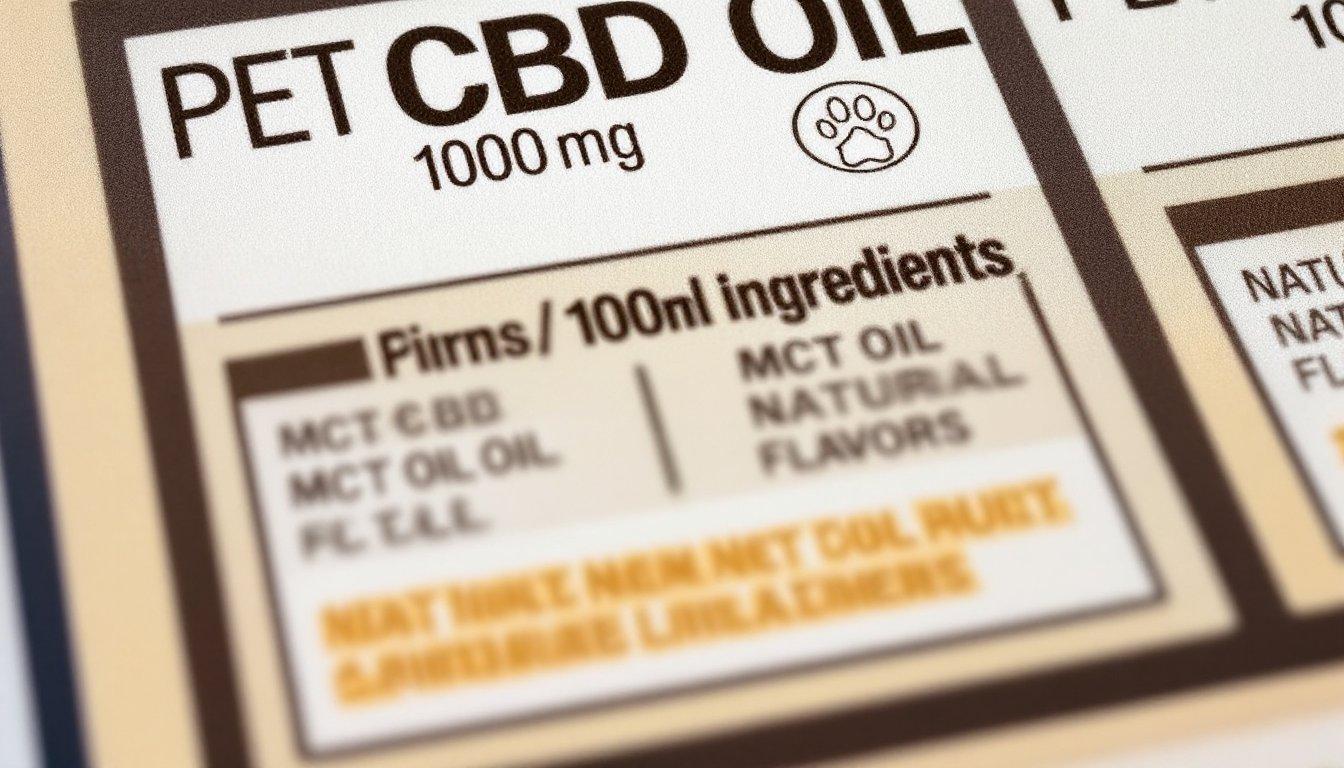
Sixteen dollars a month or ninety-three. That’s the spread between two pet CBD bottles that both say “550mg” on the front, and it’s the reason so many dog owners give up on figuring out what they’re actually buying. The front of the bottle is marketing. The back panel is information. Most people never turn it over.
Here’s the promise: by the end of this piece you’ll have a method, not a brand recommendation. You’ll know which number to divide, which word on the label deserves suspicion, and which one is worth paying extra for. Everything below works on any bottle you pick up, whether you’re scrolling a site like this one or standing in a pet store aisle with your phone out.
Plenty of shoppers start with a category browse, searching for the Best CBD oil for dogs and sorting by reviews. Reviews tell you whether a bottle arrived on time. The label tells you what’s inside it. Start there and the rest gets easier.
Why does the milligram number on the front matter so little?
Because it’s a total, and totals hide everything. A 550mg bottle could hold thirty doses or it could hold five, depending on how much oil you give and how strong the bottle actually is. The number that changes your routine is concentration, and the label prints it in small type right next to the serving size.
Do this once, with any bottle. Multiply the milliliters in the bottle by the milligrams per milliliter. If that doesn’t roughly match the big number on the front, something in the math is being presented loosely, and loose is not a word you want near your dog’s food bowl.
You’ll also see a serving count near the dropper. A bottle labeled sixty servings means the manufacturer expects you to use about a third of a dropper each time. That’s fine. Just know that a “sixty day supply” and a “sixty serving supply” are different promises wearing similar clothes.
The three labels that matter more than the front panel
Turn the bottle over. You’re looking for three specific things, and I’ll tell you which one I’d walk away over if it were missing.
- Supplement facts panel. It should list CBD per serving and the carrier oil. If the panel just says “hemp extract blend” with no milligram breakdown, you can’t dose anything responsibly.
- Certificate of analysis or a lot lookup. A batch number you can trace, or a scannable code, means someone tested that specific bottle. A generic “lab tested” badge means almost nothing.
- Organic certification mark. The USDA runs the National Organic Program, and a certified operation has to meet its production and handling standards to print that seal. It’s not a quality guarantee for your particular dog, but it’s a verifiable claim rather than a font choice.
My stance: if two bottles are close on price and one has a traceable batch, I pick the traceable one every time. The certificate doesn’t prove the product works. It proves the company is willing to be checked, and that’s a behavioral signal I trust more than a five-star average.
A label reading you can do in the store aisle
Here’s the thing that makes this practical. You don’t need a spreadsheet on your phone. You need a consistent order of operations so you don’t get distracted by the pretty bottle.
Run those five steps on two bottles and you’ll feel the difference immediately. One will get clearer as you dig. The other will get vaguer, and vagueness under scrutiny is its own answer.
What the price per milligram actually tells you
Let’s use real numbers from a real shelf. A 550mg bottle at $74.99 works out to about fourteen cents per milligram. An 1100mg bottle at $99.99 comes to roughly nine cents per milligram. Same brand, same product family, and the bigger bottle is dramatically cheaper per unit of CBD.
Bottle | Price | Cost per mg
|
550mg | $74.99 | ~$0.14 |
550mg (alternate formula) | $87.99 | ~$0.16 |
1100mg | $99.99 | ~$0.09 |
That gap is the whole game. If you don’t know your cost per milligram, you can’t tell a fair price from a markup with nice photography. And notice how the middle bottle costs more than the first with the same milligram count. Formula differences can justify that. Sometimes. Ask why before you pay for it.
One caution on pricing claims in general. The Federal Trade Commission enforces rules against deceptive advertising, and slapping a discount on an inflated list price is exactly the kind of thing those rules exist to address. When a “sale” price is close to what everyone else charges full price, it isn’t a deal. It’s a font.
The pet-specific part most label guides skip
Dog products aren’t people products with a paw graphic. The concentration that makes sense for a twelve-pound terrier is not the concentration that makes sense for a ninety-pound shepherd, and the bottle doesn’t know which dog you own. That’s your job, and it means the label math above has to be paired with a conversation with your vet about what you’re trying to support.
The FDA oversees how animal drug and feed products are labeled and marketed in the United States, and it has issued warning letters to companies making unproven claims about treating disease in pets. So read the back panel for the claim language, not just the numbers. “Supports calm behavior” is a different statement than “treats anxiety,” and the second one should make you set the bottle down.
What I’d actually do: buy the smaller size first if the per-milligram math is close, use it for a couple of weeks so you learn how your dog responds, then move to the larger bottle once you know the dose that works. You’ll spend a little more early and a lot less later. The reverse order, buying the big bottle to save per milligram before you know your dog, is how half-used bottles end up in kitchen drawers.
The label test nobody else will give you
Call it the Two Minute Back Panel Rule. Give any product two minutes of quiet with the back of the bottle. If you can answer three questions, milligrams per milliliter, traceable batch, and what the claim language actually says, it passes. If you’re still squinting at the fine print when the timer goes, put it back.
That’s the habit worth building. Not brand loyalty, not a shelf of half-tried bottles, just a consistent ten-second check you run every time you restock. Your dog can’t read the label. You’re the only one in the household who can.
So next time you’re comparing bottles, grab the one you’re leaning toward and flip it over before you add it to a cart. What number is actually printed next to the serving size, and does it match what the front of the bottle promised you?