
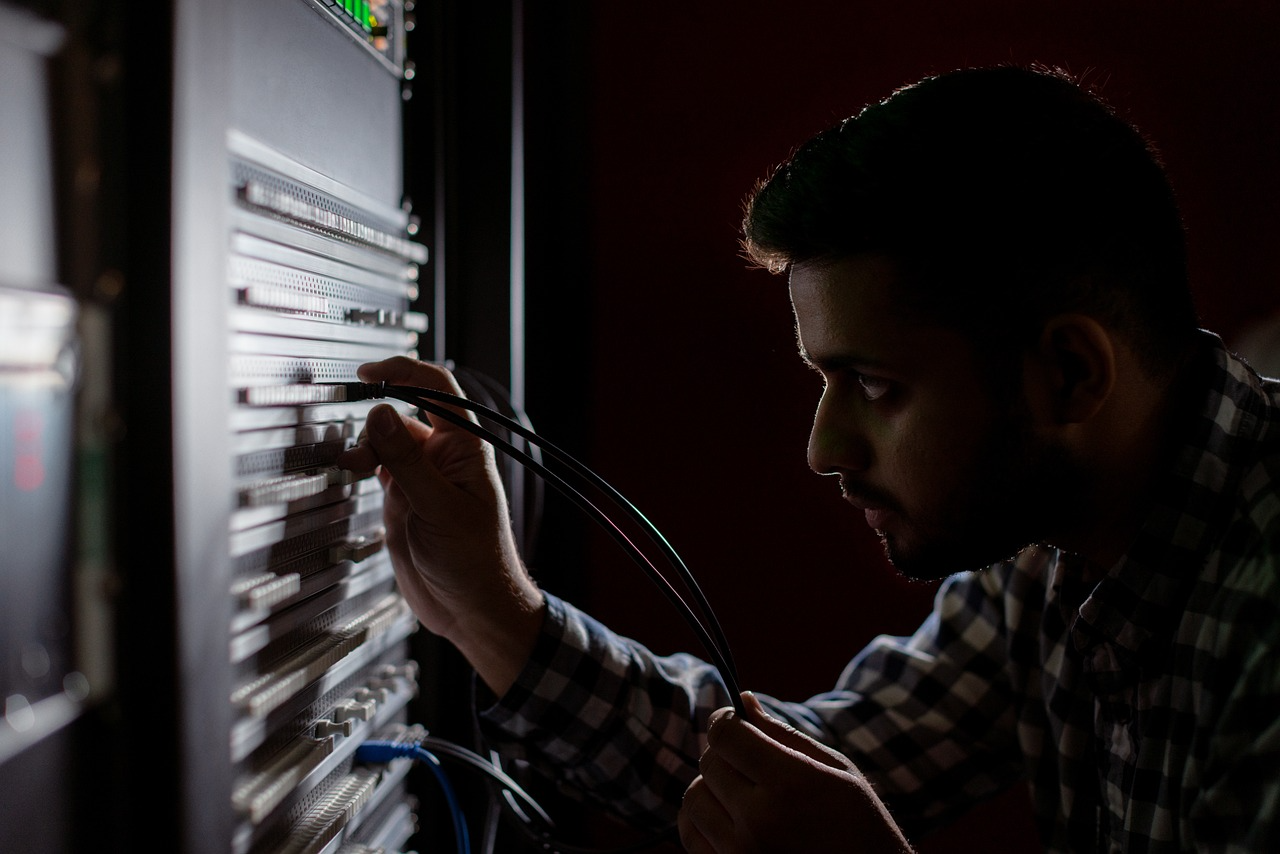
Curious about what powers today’s largest productions backstage?
Meet SDI – the unsung hero of professional video. It’s been working behind-the-scenes for more than 30 years. Every professional sports event, news channel and live broadcast you can think of uses it.
Despite all of the buzz around IP migration, SDI remains the foundation for distributing digital signals across studios worldwide. By having a robust SDI pipeline you can:
- Move uncompressed video with zero latency
- Run long cable runs without losing quality
- Build a system that’s rock solid and reliable
Let’s break down why SDI is still king…
What you’ll find inside:
- What Is SDI And Why Does It Matter?
- How SDI Powers Professional Production Pipelines
- The Different Flavours Of SDI
- SDI vs IP — The Real Story
- Where SDI Fits In Today’s Hybrid Workflows
What Is SDI And Why Does It Matter?
SDI stands for Serial Digital Interface.
It refers to a video transmission standard that carries uncompressed, unencrypted digital video via one coax cable terminated with a BNC connector. Easy as that. That’s why it is considered the broadcast industry’s gold standard for distributing digital signals.
OK, liken it to the plumbing of a television studio. When it works you tend not to notice it. That is purpose built for. SDI was created to do one job, and do it reliably: transport high quality video from A to B with no drama.
The broadcast equipment market—which SDI is squarely in the center of—was valued at USD 5.54 billion in 2024 and is projected to reach USD 9.36 billion by 2033. SDI dominates a huge portion of this industry, running on infrastructure crafted by trusted vendors like Thor Broadcast that provide the encoders, converters, and distribution equipment sending SDI signals through professional workflows worldwide every day.
Why is SDI such a big deal in pro video?
Because it solves problems that IP-based systems still struggle with:
- Zero latency: What goes in comes out instantly. No buffering. No hiccups.
- Locked connectors: BNC connectors have a mechanism that literally locks the cable connector so it can’t accidentally come unplugged during broadcasting.
- Long runs: You can run SDI hundreds of feet without signal loss.
- No compression: The video stays pristine from camera to switcher to recorder.
For live broadcast, those four things are non-negotiable.
How SDI Powers Professional Production Pipelines
Let’s walk through what a typical professional pipeline looks like.
During a live sporting event production there may be 20+ cameras on the field of play. Each camera is sending an SDI signal back to the production truck. The signals coming into the truck are fed through a router, into the switcher, out to monitors, recorders, replay systems, graphics machines, etc.
Every single one of those connections is SDI.
Why? Because when the director is switching between cameras live there can be no half second delay, no frame of compression artifact. The picture has to be pristine every shot.
Here’s a typical SDI pipeline path:
- Camera output → SDI cable
- SDI cable → Router/distribution amplifier
- Router → Production switcher
- Switcher → Master control
- Master control → Encoder for transmission
News Stations. Esports Broadcasts. Megachurches. Concert Tours. They all follow this same basic flow.
The Different Flavours Of SDI
SDI is not a single standard. As higher resolutions/frame rates have become common place, the standard has grown to encompass several variants. The versions you will see are:
SD-SDI
The untouched original recording. Designed to be used with SD video at 270 Mbps. Rarely used these days for new builds, but lots of legacy equipment will output this.
HD-SDI
The one that emerged in the 2000s during the transition to HD broadcasts. Operates at 1.485Gbps and is capable of 720p and 1080i video.
3G-SDI
This is where it became serious. 3G-SDI operates at 2.97 Gbps and supports 1080p resolution at 60 frames per second. 3G-SDI has become the de facto choice for professional video due to its ability to handle higher resolutions and frame rates over longer distances.
6G-SDI and 12G-SDI
These high bandwidth variants allow for 4K UHD video over a single cable. 12G-SDI is quickly becoming the standard for 4K production due to its simple workflow of one cable, one camera, one signal.
SDI vs IP — The Real Story
You’ve probably heard the buzz about IP video taking over.
Broadcasters are indeed slowly transitioning to IP. The broadcast/media production vertical makes up about 32% of market value as broadcasters upgrade from SDI to IP-based infrastructure. However, what they don’t tell you….
The migration is slow on purpose.
IP video does have advantages – it is flexible, scalable and (at scale) has lower cabling costs. However it also introduces:
- More latency
- Network complexity
- Synchronization headaches
- Higher dependency on IT staff
For the vast majority of live production applications, SDI is still easier, more reliable and less expensive to deploy. That’s why nearly every IP based studio in the world has SDI islands inside of it. Cameras output SDI. Monitors receive SDI. Recorders love SDI.
Where SDI Fits In Today’s Hybrid Workflows
Production pipelines are moving more towards being hybrid these days. SDI for local signal distribution and IP for long haul and remote production work.
Here’s how it usually breaks down:
- Studio floor: SDI between cameras, switchers, monitors
- Master control: SDI to IP gateways for transmission
- Remote production: IP for sending feeds back to a central hub
- Distribution: IP and streaming for final delivery
This solution has gained particular traction as live streaming surges in popularity. More than 70% of European media companies reported streaming over 100 live events per month in 2024. All of these live streams have to originate from somewhere – and that somewhere is most likely an SDI camera plugged into an encoder.
The encoder converts that clean SDI feed into a streamable/computable format that can be streamed to the internet, recorded to a server or broadcast over a network. SDI does all the work on the front end.
Final Thoughts
SDI has been around for over 30 years and it’s not going anywhere soon.
SDI is still the most ubiquitous and lowest latency option for digital signal distribution in professional video pipelines. Standards will continue to evolve and IP will continue to expand, but SDI will always be the base that we layer everything else upon.
To recap quickly:
- SDI moves uncompressed video with zero latency
- It’s the standard in live broadcast, sports, news, and events
- 3G-SDI and 12G-SDI are the current go-to versions
- IP isn’t replacing SDI – hybrid is the future
Whether you are building a new studio, or retrofitting an existing facility, SDI should be the foundation of your build out. It’s the dull workhorse behind the magic of great video.